Tuesday, March 31, 2015

Computers in Schools

Tonight in class we briefly touched on gaming and computers in schools. I can't speak for all the schools, but my daughter is in a 4th grade class with 17 other students and they do have computers in their classroom. There are only five, but all students get a chance to use them. Each student gets a chance to use them to start teaching the kids the basics of computers. Along with that they also practice typing and use educational games. I suppose it would be kind of like a more age appropriate ABC mouse where there are games to help them with math and reading. I know all public schools don't have this, but to me it shows that schools are adapting to the new technological ways kids learn and are conditioned to learn and function in today's society.

Add On To Patrick - Tyree Carrow

To add on to what Patrick had said about how technology is basically taking over the world, I believe what he said is true. Technology is really taking over the world, we can't do nothing without the usage of technology. I personally can't go somewhere in far distance without my phone because I don't know many numbers by heart, I don't know my sense of direction unless I've been there before. In addition, without our technology, we will be living like Cave Man. We would have to cook food by natural sources, be able to communicate without the use of Instagram, Facebook, Twitter, and so on. Students, especially me, would suffer without the availability of technology. I could navigate my way through a textbook, but I wouldn't depend on it and I will definitely not learn as much as I would by watching videos or clicking on different links reading different sources about a certain topic that I am assigned to research. 

Media being God like

In the text: "Media: The Second God" Tony Schwartz implies that media is a God like form. From his perspective he establishes that Media has shaped our world-- as well as how we can shape the media in many different ways. He discusses that media is everywhere, at all time. I feel as though media sets an image for people to follow, therefore it is God like only in this sense. Media helps achieve greater knowledge of things that people are unaware of but at the same time misconstrues reality to some degree. This relates to religion in the sense that, everyone follows something different, yet only relies on a greater power out of influence or fear. Depending of what religion people follow, there is no correct answer. Within media, society devotes there time to advertisements and television so they can focus on things and not have questions unanswered. In conclusion, media consumes our society just as much as religion. It set standards for the way we act, live, and speak.

WEEKS 11-13 HOMEWORK

1) Familiarize yourself with these terms:


2) Watch this documentary, “Future is Today: Humanoid Robots” (40 mins)


3) Watch this episode of “Through the Wormhole” (43 mins)


HOW DOES THIS COMPARE WITH SOCIAL MEDIA?


4) Media Literacy
           
4a) Convergence Culture/Participatory Culture – Watch these videos:


4b) Read “Nurturing Affinity Spaces and Game-Based Learning” by James   
        Paul Gee and Elisabeth Hayes

                  drive.google.com/uc? 


5) MP3/Sound Studies

Read “The MP3 as Cultural Artifact” by Jonathan Sterne

Software Takes Command (recommended)

I'm re-posting the Introduction section of Lev Manovich's most recent book "Software Takes Command." This is no longer required reading, but I will cover some basic terms/keywords in class. This reading is a must for anyone interested in researching software for their final paper.

drive.google.com/uc?export=download&id=0B3PfaHNULqy4WE5jQjdXNEx4cG8

Also check out Manovich's data visualization work: manovich.net

Patrick Q

 we keep coming back to computers and it becoming a prosthesis. this is a topic that i think is pretty serious, but is kinda shrugged off by society. when the industrial revolution happened the people who's jobs were replaced by machines went out into society and found and alternative. they went out and improved their mental powers and found jobs in more advanced jobs. there was a area to go for all the people who lost their jobs to machines. today it is a different story. we are kinda in a technological revolution and the machines have evolved. this time around the machines are taking over the brain jobs rather than just the physical jobs. so there is no where for people who lose their to machines to go . the tedious and physical jobs will be taken by machines and the thinking will be replaced by computers. now when you combine that with the possibility for a computer to start to learn and make its own decisions, its a scary possibility. technology is already creeping into our every step, watching and recording us. how far will it go before it is too late to turn back or take back control.

Patrick Q


   so i been thinking about that article that you gave use one of the first weeks. the article allegory of the cave. at first i though it was kinda stupid. but the more i thought about it the more i started to see it in a different way. at first i thought that unless the people had been chained to the wall from birth they would realize that the shadows were from people who live in the world they used to inhabit. being a person who lives in the present age i also didn't appreciate the message that plato was trying to portray. its a pretty abstract idea, especially back then. there wasn't any internet or a world wide organized education system that has tons of classes on philosophy. i mean i guess thats why he is considered one of the fathers of philosophy.

It Follows

"It Follows" is a film that just recently came out that I saw in theaters this weekend. It was a film advertised, and would have been thought to have been a mainstream media movie. Much to my surprise the film had a very indie feel to it. All the actors were fresh faces, and the music was all produced by one artist "Disasterpeace". What was most appealing to me about the movie is that almost every shot had some type of movement to it. And every shot was planned to be cinematically appealing. The content was interesting, but the execution of the shots was beautiful. This was great to me because I feel as though movies in theaters have lost their movement. Most shots are just still and you're just enjoying the content within the film. Whereas this was more about how the shots were taken than anything to do with content. It had a specific shot where the characters are sitting poolside and it's panning across them as they're posed. To many people it would appear irrelevant and strange, but to someone who enjoys movies for their cinematic quality I loved it. The lighting was blue and dark, and it was beautiful to look at. A lot of the shots were rigged to vehicles and even a wheel chair in one scene to create a raw movement. It felt as though it was a movie I myself could have directed and filmed. I think that a lot of movies have lost their cinematic value and are all about keeping people entertained. Which is fair, but CGI and still shots become lackluster to someone interested in film (for the lost part). Each shot was planned to give moods with lighting, movement, and sound. Love was put into the movie and you could see it. Most of the movie was also done in very little shots since there was so much movement. It was more about camera work and scenes rather than editing and that also made it more interesting to watch. The film also had a montage feel where a lot of the shots were scenery or just face shots spliced, and that made it seem even more raw. All in all this filmwas excellent in terms of camera shots and production.

McLuhan’s Prediction of the Loss of Privacy Through Computers

Marshall McLuhan originally published “The Medium is the Massage” in 1967, yet in it he mentions, “Electrical information devices for universal, tyrannical womb-to-tomb surveillance…” So far in the 21st century one of our largest societal conflicts has been in cyber-space, over this debate about what is private and what is public.
How much work do these electrical devices McLuhan mentioned have to do to track and spy on our every move when most people put their every thought, action and life event-no matter how trivial- on Facebook, Twitter or Instagram? The National Security Agency (NSA) has spent a large amount of its time and budget collecting exactly this information which people share freely. Though apparently when it’s done by a government agency people seem to freak out. Who gets to decide what is private when we spend so much of our time making sure everything we do is known by all of our “friends” and followers? Why do people feel the need or right to react negatively to this information being known by strangers sitting at a computer screen in dark government cubicles

 McLuhan envisaged this conflict between, “...our claim to privacy and the community's need to know.” and mentions the “…new methods of instantaneous electric information retrieval,” decades before server farms took up acres of space at a secret location in the desert. If this seemed like such an obvious occurrance to McLuhan in the mid 1960s- when computers took up entire rooms worth of space- then why has it taken till now for us to catch up to him? Why did we fall into the exact pothole that McLuhan seemed to have seen coming and tried to warn us about?  

Importance of "New Media"

What was referred as New Media a decade ago was very different then previous technology. The bigger evolution is that ten years after that, technology has exploded and evolved but evolved differently then what we thought.

In the 1960s shows like The Jetsons saw the 2000s, as the new age. Life itself would be very different. This was perceived thought all sorts of media. Movies like Demolition Man starring Sylvester Stallone which shows Stallone entering the future to unheard things. Movies like Blade runner starring Harrison Ford which perceive the future as a place that is better and more superior to the world we currently are living in.

Now in 2015, we are not living in a world with robots, or shuttles, or anything like we thought it was going to be like in our science fiction movies. We live in a world with the ipods, smartphones, tablets, smart televisions, 3-D movies, and high end computers. Our world is so dependent on the internet and it's devices. Simple things like banking is used on such devices. I mean we can't go anywhere or do anything anymore without computers. You pick up a book, it was made through machines, most likely written through a computer of some sort.

Things that I enjoy like vinyl records were not popular five years ago. Now in 2015, they make vinyl records of mainstream bands. Technology seems to recycle itself, but the wave of fans of vinyl records are not nearly as big as fans of the ipod or the ipad. Vinyl records now are made limited edition to increase it's popularity and it's value. People don't buy vinyl records to listen to anymore, they buy it as a collector. I want to buy the new vinyl lp to listen to it; it's more easier to get it off of Itunes or take it off youtube. It's really that easy to take music in 2015.

Some days New Media gets me confused. The simple things I was bale to do two years ago, I have a hard time with because, hey we changed this and this and now you need to buy this product to do this. I remember when it was a simple wire to hook up a VCR to a TV. Now to get a Blue-ray player to work with my TV, I need to buy a HDMI cable for ten dollars, when the old wires I could go to the dollar store and get a simple component wire. Times have changed, but really are they better?

Sunday, March 29, 2015

Cinema and Color Schemes: Star Wars
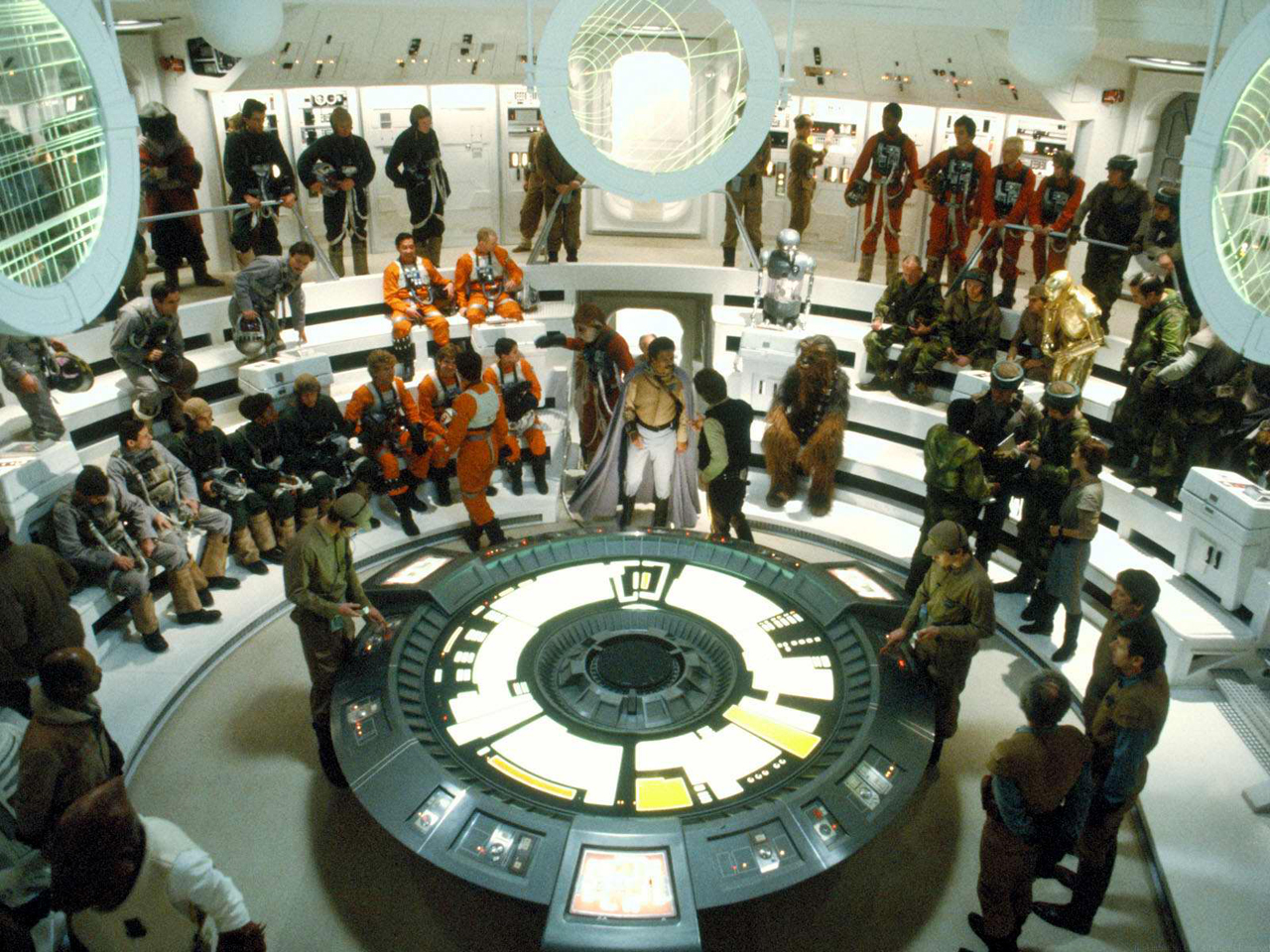
Star Wars, one of the most iconic film franchises born in the 70s, and by the end of this year will have a new movie to start a new trilogy, but I have noticed something in the classic Star Wars trilogy when it comes to the Rebel Alliance and the Empire, its color schemes reflected its affiliation, for example the Rebel Flagship Home One


Whites, Oranges, Reds, and Silvers are the Primary Colors of the Rebel Alliance

They usually give a safe, secure, positive presence, their colors are soft, warm, and yet firm and serious, it also has a few sharp blues here and there, it makes the ships and buildings nice to look at, nice to be in, and the flagship Home One has a feel of a sanctuary.

Now take a look at the Empire, its Death Star II

Greys, little Whites, Carbon Black, little accents of Blood Red and Copper are the Empire's Colors

A very strict and cold colors, harsh and oppressive, also it should be noted that the Nazi's had colors of grey and black with bits of red mostly with the SS, which some say the Empire's motif was based on, I agree more or less but thats a different debate. The whole point is that you can tell this formers-Republic has been infected and corrupted by the Sith, and if you play the Knights Of The Old Republic series, the Sith Empire was a lot like this, only with more black.

Pop-Culture Cinema has used this type of formula heavily when they make film franchises they want to be memorable, and I say its a rather brilliant one.

Tuesday, March 24, 2015

Music in "The Man with the Movie Camera"

The inherent paradoxical nature of “The Man with the Movie Camera” is that even though you are looking at images flashed at such a fast pace, instead of the effect being jarring it serves to draw you into the film. The fast  paced, harsh tone of the score combined with the rate the images are cut at works to engage the audience when the scenes are moving quickly as opposed to knocking them out of the first hand experience of watching the city’s inhabitants. Even though the pace changes occasionally, it is consistent and deliberate. The effect of the combination of the speed of both the sound and image places the viewer into an almost trance-like state so that the information the images are displaying can hit them harder. The point of “The Man with the Movie Camera” seems to be the every day life of a normal Russian city, but when it’s stylized as in this film the images take on a beauty and life of their own. “The Man with the Movie Camera” seems to be as much an ode to the magic of film editing as the city we are shown. In Walter Murch’s metaphor every cut is a blink, but in this film we don’t mind the effect. 

Intellectual Montge

The significance of Intellectual montage is prevalent through the history of film. "Man with the Movie Camera" was one of the first films to portray a realistic and abstract juxtaposition of the rich versus poor structure. The intellectual montage is presented in a scene where a woman is getting pampered, smiling and laughing, while a different woman is characterized working outside, covered in dirt and sweat. As the shots change back and forth between the two women, the viewer begins to understand the emotion of the struggling poor woman versus the rich pampered woman.The general focus when viewing intellectual montage is emotion and perception of the shots. The meaning does not exist in the individual shots, but rather only when they are juxtaposed.  During this montage, the viewer begins to think more deeply about how the two contrasting illustrations depict the two women living completely different lives, which gives it a dominant emotional effect. In conclusion as a result of editing, intellectual montage was a significant cinematic technique in "Man With the Movie Camera".


Man with a Movie Camera


"Man with a Movie Camera" was a rather experimental film and was innovative for the time it was made in. The film comprised of many random shots all over the world that in the end, told a story. Many different angles are seen throughout the film and the editing of the film for the time is impressive. The director of the film portrayed many opposites in the film such as the women getting their hair done compared to another shot of lower class women to show the contrast. The editing was very specific to go with the pacing of the music. When the music would get intense and fast,the scenes would cut accordingly to the fast downbeats and then slow down when the music slowed down and this would also be used to produce different moods such as a feeling of calm or a feeling of chaos.

Sunday, March 22, 2015

The Man

Recently in Media and Society class, we screened The Man with a Movie Camera. This film was made in 1929. Being an early experimental film, the entertainment value of this production is almost as significant as it was in the late 1920's. It was amazing being exposed to the general way of life eight and a half decades ago. In relation to the time period the film was released, this film was a story with no actual story and no scripted characters. The main character was the actual man with the camera.

The man was in the world collecting random shots that in the end told a story through symbolism. The audience was exposed to an event, then the opposite of the first event. For example, illness and death was presented, then a woman experiencing birth and then the baby being born. Then symbolism was shown to support the opposites; an example was the change in direction of the traffic signs. This style and content portrayed in the film kept it interesting at all times. It was never obvious what was going to happen next.

I also found the dangerous methods of getting the shot very appealing. The cameraman would go to any extreme to get the shot. He stood either in the back of a truck or on the edge of a building quite frequently. The style of seeing him get the shot then viewing the captured motion picture through his lens also added to the excitement.

This screening of The man with a Movie Camera was a great experience and also entertaining. The randomness and conflicted shots were the best parts. Messages were presented and translated to us viewers in very basic and affective ways. At the end of the day, whether its today, or in the late 1920s, this film made its audience think similar and different ideas through the medium of cinema.


Saturday, March 21, 2015

Man with a Movie Camera

This was my second time seeing this film. This “Man with a Movie Camera” is a silent film directed by Dziga Vertov and edited by his wife Elizaveta Svilova in 1929. This movie had no actors or a story line which made it difficult to watch and get a grasp of the directors purpose. While viewing this movie I paid more attention to the cinematic techniques, like the camera angles, jump cuts, close-ups shots and the movement of the film. Although it was a difficult film to watch the score moved the scenes along rapidly and smoothly at times. I took some time to do some research about the film because I felt there had to be more to it than just editing and cinematic techniques. Dziga Vertov “felt films were locked into the tradition of stage plays, and it was time to discover a new style that was specifically cinematic”. He also felt that “Movies could move with the speed of our minds when we are free-associating, or with the speed of a passionate musical composition” This film took four years to film and was editing from 1,1775 separate shots. The link below gave me a better perspective of the film.

Click the link below 
http://www.rogerebert.com/reviews/great-movie-man-with-a-movie-camera-1929


Tuesday, March 17, 2015

Man With A Movie Camera 1929

I'm really not a big fan of silent black and white movies, but watching this particular movie really grasp my attention. I found it very interesting that the editor can perfectly line the cuts throughout the movie with the music. For example, there was a part in the movie where the people were slowing down, and the editor also made the music slow down as well. To me, it seems like you'll need a lot of patients and skills to execute that. I also found that the birth scene was very shocking to me as well. I would have never expected it from an old fashioned movie. I love who the editor can capture "real-life" in his project, and show what people go through on a daily basis.  I would also  like to point out that this movie, (as discussed in class), is self-conscious. This movie make the audience aware that they are being manipulated. I find it very funny when I'm watching  a comedy show, that the actors would sometimes inform the views that they "know" their acting, and it's all fake. We also discussed before class that Vertov's wife got him into filming as well. Since this movie dated back to 1929, today, 2015, I still see a lot of filming techniques that were used in the past that transitioned over years later. That is how you know that media is a very powerful source,

Man with a movie camera.


Although I do like some older black and white films, silent films usually don’t hold my attention. Man with a movie camera seems to be an exception to that. It is so unique and confusing at first watch that it held my attention, and intrigued me. After watching it again I was able to see how it was displaying the different people, industry, culture and life of this area. He did this wonderfully without using any actors, even though he, his wife and even the camera seem to take on roles as characters in the film. His wife had done an amazing job editing the film. My personal favorite is the human eye over the camera lenses, as if they are fusing together as one. At such an early stage in the film industry the way she was able to pull off so many different editing techniques in this film is incredible. This film is a perfect example of a long montage and it is a creative film that was ahead of its time. It’s no wonder this film is rated so highly and used as a teaching aid.

Monday, March 16, 2015

Man with a Movie Camera

After watching Man with a Movie Camera, I was amazed in how unique the film was. The film is essentially a montage of urban life in Russia during the span of one day. It was nothing I have ever seen before and I have seen thousands of movies during my lifetime. There were a wide variety of unusual camera angles and editing techniques that were seen throughout the course of the film. After watching it a second time, I got a much better understanding of the purpose of the film and its techniques used. I picked on something very interesting that stuck out to me that I did not notice while watching the film in class. The music playing in the background directly correlated with the images on the screen. For example, during the film when the people were rushing through the busy streets, the music was fast and upbeat. Another example of how sound directly corresponds with the film is when the woman is shooting the gun, there is a popping noise as she shoots the rifle. Obviously, these were just a few of the many ways that sound correlates with what was being portrayed on the screen. If you were to just listen and not watch this film, I think you could understand what was happening at the time. Obviously, this film is very erratic but by just listening you could imagine and picture in your mind what could be happening and it is all made possible because of the orchestra.


https://www.youtube.com/watch?v=7ZkvjWIEcoU

Friday, March 6, 2015

Cave drawings relating to cinema

In Werner Herzog's: " The Cave Of Forgotten Dreams" media is portrayed through the abstract cave drawings dated over 30,000 years ago. When analyzing the drawings in the cave scientists understand that the paintings were created as actions. The majority of the drawings were made upon slight curves in the walls which in this sense, establishes motion. I believe the drawings were meant to be made like this, because it helps people gain a better understanding of what is happening in the images. The artist wanted people to understand how animals act, so they portrayed it through the only way they could. The paintings tell a story which also makes it a complex and interesting form of cinema. The animals are fighting aggressively and the images easily establish this to be true. The artist created patches of faded dust clouds, as well as overlapping drawings of animals to depict them running, fighting, and even mating. It also shows animals running in motion just as objects move in motion within cinema. Overall, the cave drawings are significant because they convey original forms of media.

Significance of "A Corner in Wheat"

Film first began by depicting life issues that society could easily relate to. People were able to watch something that represented material in there everyday life. By doing this people felt as though truth was being told, and for the very first time people were witnessing it through something they had never seen before. "A Corner in Wheat" symbolizes one of the most important films ever made for this reason. Along with the ideal composition, shots, and acting, it also told a story of the struggling social class in America during that time period. The story illustrates a wealthy business mans attempt to corner the world market on wheat, which destroys the lives of people who were no longer able to afford bread. When viewing the film the audience tends to feel sadness because the story successfully portrays the struggle that the people were facing. When people viewed this movie in 1909 they could understand and relate, due to the fact that the movie established relatable life issues. Many farmers in reality faced the same struggles as the wheat farmer in the film. In this sense cinema such as "A Corner and Wheat" was telling the truth and facing reality. By conveying these issues through film society was able to relate to the social struggle Americans were facing at the time.

Thursday, March 5, 2015

How the Victorians Wired the World

The telegraph

The telegraph was developed by Samuel Morse and other in the 1830 and 1840. These inventions changed the way we communicated. The communication was transmitting over a electrical signal over a wire, which was the first form of communication. It definitely laid the foundation for other forms of communications like the telephone, the internet and other means of communication. It allowed messages to be sent instantly, as it became more advance the messages were able to be sent at a longer distance by the pressing of a few buttons. Although individuals may not have felt the impact of the telegraph it did have a great impact on the society by transforming the working of government and industries. The telegraph did not directly affect people's live but it did make things work for quickly and efficiently for the railway transporting goods and material. The primary owner of the telegraph were business owners. In class, we discussed how businesses owner used the newspapers to attract costumers. Many years before the invention of the telegraph the newspapers used mail coaches and couriers as a means to communicate. After the 1850s, it became easier to transmit information cutting it down from a week or days to hours and minutes. It also allowed the flow of news to reach a mass amount of people around the world. 

Tuesday, March 3, 2015

The advancement of technology affected how generations absorb the concept of what makes a good film

When cinema began to affect general population as a whole rather then be a gateway or privilege based on economic stature, technology was advancing so quickly that almost every couple of years the next idea revolving around cinematography was being introduced. In modern world, many people look past alot of traditional film techniques and look for special affects. If a movie lacked in special effects, certain viewers would look at it differently but this comparison to the average movie watcher doesn't stem from content or quality but by how much or how visually stimulating one can you make a film. This reflects the idea of how technology affected these generations. In modern 1st world society, a life without movies or special effects or even video games seems unreal. We are spoiled with amazing HD quality and affects that would leave older generations speechless if given the opportunity to experience what we have considering they had. This idea isn't negative, it actually stimulates the idea on what could be the next technique or advancement in the future. A perfect example is 1st person camcorder styled movie. These movies became super popular in the "2000s" where it wasn't really done much if at all in the past. It made its breakthrough and lots of movies using the technique flooded cinema. As a phase and as time moves on it is now just another technique. Another is when CGI was a rave. Almost every movie would spam CGI and rely less on acting and camera use and more on green screen. I conclude this with stating that i feel fortunate to live in such an advancing society and im excited what cinema/media has to offer in the future

Cinema as an Attraction

In the past cinema was simply an attraction, a way to amuse people and grab their attention. Over the years, cinema has grown to be much more than a few amusing pictures in sequence, it has the capacity to tell full narratives and deliver important messages to the audience. However, even though cinema today has the capacity to tell important stories, it doesn't mean cinema is no longer used as an attraction. Feature films such as Pacific Rim or Avatar show that cinema can still be about amazing the audience with special affects and aesthetics. With the technology we have available, movies can center around affects to captivate an audience while simultaneously moving along a narrative. Aside from full feature-length films, social media provides their own type of cinematic attraction. Videos on facebook, instagram, youtube and vine are usually very brief. Vine has a maximum length of 6 seconds, instagram 15 seconds. These short videos are very similar to the early versions of cinema in that they provide only a quick fix of entertainment. They are novelties, meant to amuse and grab attention, whether for a nickel in a Kinetoscope or through facebook for a like.

Class Tonight

Hi all,

Although class is cancelled, and I caution everyone to avoid the roads, I will remain on campus for a short period of time if anyone wants to consult with me regarding their research paper.

Homework for next week: please read the 4 chapters I assigned from the Schwartz text (see earlier blog). I have also posted a download to PowerPoint that I discovered that I put together for a class a few semesters back. Please review this, as well. It should be helpful. I would also like o ask everyone to watch the film "Triumph of the Will." You can find it on YouTube here:

https://m.youtube.com/watch?v=GHs2coAzLJ8

We also have th DVD in our library in the com office if you would prefer a slightly better quality print of the film. We will discuss next week, but this should allow us to stay on schedule.

Stay safe!

Zoetrope


After the class discussion last week it made me think of a toy I had as a kid, a zoetrope. This was a cylinder with slits in in and you could change the different comic strips or drawings inside it, then once you spun it you would look through the slits in the side and it would make the images appear as if they were moving.  Obviously the one I had wasn’t as popular as when they first came out in the early 1800’s, and even some say a Chinese inventory had actually come up with this around 100 BC. This was an early form and a stepping stone towards motion pictures, but it still has its place in society today. Over twenty years ago McDonalds was giving these out as toys, so even though there were movies these still had some sort of appeal.  This is still something that is done in some subways.  There are pictures painted on the walls with the beams separating the pictures, so as the train goes by these images appear to be moving. It might be a silly thing and out dated, but it still has a place today amongst all this modern technology, and we are still captivated by the illusion.

Kinetoscope/Cinematograph

The Kinetoscope and Cinematograph were created at the turn of the century and ultimately changed media forever. The Kinetoscope in 1893 from Dickson/Edison was the first personal film viewing device that was develiped for the public. There were other inventors around the world trying to create the same thing which to me poses the question. Had other advances in technology lead to people pushing to invent such a device, or had the education system progressed to a point around the globe that people were finally gaining enough knowledge to create such devices, or was it just a "coincidence" that these devices of similarity started to pour into the market around the same point in time? These three points I brought up are very much so controversial and are very hard to prove which of them is the true reasoning behind the inventions timeliness in the 1890s. I have yet to find the real answer but would like to find out.

Patrick Q

The other day in class when dana was there you eluded to thinking that sound or audio ruined cinema somewhat and changed it from a form of art that didn't require the viewer to be literate. A person could just sit back and watch the film in front of them and absorbed it rather than be bogged down by also having to interrupt the sound. i would tent to agree for the most port. when watching a movie i can see whats happening. i can see the action. i can see people expressions and reactions to others. the way the angles are shot in can bring about an emotional response without having to use sound. last semester we had to watch wall-e and the only version i could find on youtube was in spanish. even without knowing Spanish and not to mention there is huge parts of the movie where the robots didn't speak. even with out those 2 things i was still able to grasp and interrupt the movie.

Understanding Media Powerpoint

Please read/review this powerpoint for week 7.

drive.google.com/uc?export=download&id=0B3PfaHNULqy4UkVVSS1veno2Vm8


The importance of the telegraph

Over the past 100 years their has been many advances in technology. There is no doubt that technology has affected our society and surroundings in a variety of different ways; both positively and negative. In many societies, technology has helped develop more advanced economies and in China and some other parts of the world advanced technological processes have been devastating to the earth's environment. But how did we get to where we are today? In the last discussion on February 24th we spoke about the telegraph and how it shaped the start of advances of different types of technology. The telegraph which was a machine used for transmitting messages in the form of electrical impulses played a major role in communication during the late 1800s and 1900s. This device made it possible for transmitting and receiving messages over extreme long distances. I believe without the invention of the telegraph other inventions such as the telephone and internet and other means of communication would not be around today. Obviously this is just my opinion but I do believe the telegraph how a huge impact on the technology we have today. It paved the way for new advances in technology and ultimately made the world seem much smaller.

The Telegraph (blog 2)

In the last class discussion, (February 24th) we spoke about the telegraph. This dates back all the way to the early 19 Century. I personally feel that without the telegraph, we wouldn't have the advance technology we have today, and to communicate efficiently. The telegraph was the starting point for the advancement of different technology Mr. Bordino stated that the telegraph, (for the first time in history), allowed messages to be done "across space", in other words, it breaks down special borders. Before the invention of the telegraph, people had to physically cross a "space" to deliver a message to a person(s). This created different geographic area to connect to make it easier to communicate. This made the world a- lot smaller again, in regards to communication. This also established the idea of time zones. I found the telegraph very interesting I had to do extra research. According to "personal.edu", the electrical telegraph was invented by Samuel Soemmering in 1909. They used Gold wires in water sending messages around two thousand feet away. I also found it interesting that in the Greek language, telegraph can be broken into words, Tele and grapheintele. In the article it states that the word "tele" means far and "graphein" means to write. I also found it interesting that the “simple forms of telegraphy were mostly smoke and lights beacons. I personally didn't know what “beacon” meant, so I searched on Wikipedia to get the definition. According to, Wikipedia.com, “beacon means a beacon is an intentionally conspicuous device designed to attract attention to a specific location”.       

Birth of A New World

In the late 1800s, the groundbreaking Kinescope, Phonograph, Cinematograph, etc. were invented. Early film, and film as a whole was born. Film shot on cameras were now possible to be viewed by an audience. Whether it was a woman dancing in a large dress or a film of a man holding his face next to a woman then kissing her for half a second, a new world was introduced into society.
     
         The points of the films were to entertain an audience. The films immediately influenced the audience; similar to ideas in films today. After "The Kiss", the man who did the kissing was an instant celebrity to people viewing the film. He was labeled as a good kisser and women would approach him asking him for a sample of his expertise. For the first time, people had the opportunity to view an idea in a form closest to real life. People say during the screening of the "Black Diamond Express" some of the audience believed they were actually going to get hit by a train and would jump out of the way of the oncoming train. 


     These basic films evolved into narrative films with a storyline. The power of film cannot be described. From basic ideas to huge life-changing ideas, film is one of the most influential forms of media in society, and it has been since it was first introduced into our world. Moving pictures are universal; you don't need to know a language to view images. This new form of media changed the world, and continues to change the world and almost everyone in it.

Monday, March 2, 2015

Film as an Attraction

Film in it's early stages was seen primarily as an attraction. Much like a ride, or a circus performance. Then began an age where they became an art form. Where film was used to present an idea or message in a beautifully cinematic way, rather then just some form of entertainment. An excellent example would be the film we began watching "Man With a Moving Camera"; although, not everyone's favorite, it's still a beautiful film illustrating the use of just a camera and the world around you to convey an emotion or a story through a montage of shots. Film has met many stages though throughout history. It seems that some of the most popular films now are ones aimed more for entertainment purposes though, rather than to express an artistic view on life. For example some of the biggest box office hits are movies consisting of almost entirely just CGI rather than any actual filming skills. These movies include Iron Man, The Avengers, or any movie of that genre. They're movies you go to to see the hot babes, the explosions, the super rich guy who gets everything he wants. Now of course I'm not bashing these films, although I should in the eyes of most filmmakers since they're just "money making films, and lack any real substance." I too enjoy entertainment as much as the next person. They're movies all about making you laugh, making you excited, and allowing you to see your favorite characters come to life. They're the films that allow you the feel an energy as if you are too fighting the bad guy. But, the sad part is this means the films that are true beauties a lot of the time don't get as much recognition. They're "boring, pretentious, lame, too emotional, etc." Which is not true in most cases. There's something perfectly lovely in watching a movie with true cinematic beauty. One where you sit there and gaze at the shots because the angle is just perfect, or the lighting makes your heart feel warm. The acting is raw, and although it may be slow there's so much passion you couldn't care less. This is why I want to go into cinema, to touch people with my own mind. That being said, it's hard to sell a creative mind in a fast paced world. Everything humans do can be seen as some kind of attraction. Humans are constantly filling their time with only things that make them laugh or are just the surface of human existence, ignoring what's really surrounding them. Of course this can't be said for everyone, but for the general population it seems to be the case. So, now if one day my career leads me to working on the next Star Wars movie, then so be it. It would not be a failure or a sell out, but an opportunity to make someone feel excited, and to root for their protagonist. At the end of the day everyone just needs to feel good about something.

Cinema's infancy

The Kinetoscope, a small, coin-op, crank-handled boxy device that was one of the many technological marvels during the turn of the century, as I have read from Gunnings article, the idea did not much traction yet seeing it as a minor fad by critics of the arts, but as inventors began to tinker, fidget, and experiment with idea which evolved over time into cinema, which would be another form of the arts. The Luminere Bros of France developed a larger version of the kinetoscope called the Cinebooth and later one the Phantscope which was a leap into projecting large films which would lead to what we see in theaters today.