What was referred as New Media a decade ago was very different then previous technology. The bigger evolution is that ten years after that, technology has exploded and evolved but evolved differently then what we thought.
In the 1960s shows like The Jetsons saw the 2000s, as the new age. Life itself would be very different. This was perceived thought all sorts of media. Movies like Demolition Man starring Sylvester Stallone which shows Stallone entering the future to unheard things. Movies like Blade runner starring Harrison Ford which perceive the future as a place that is better and more superior to the world we currently are living in.
Now in 2015, we are not living in a world with robots, or shuttles, or anything like we thought it was going to be like in our science fiction movies. We live in a world with the ipods, smartphones, tablets, smart televisions, 3-D movies, and high end computers. Our world is so dependent on the internet and it's devices. Simple things like banking is used on such devices. I mean we can't go anywhere or do anything anymore without computers. You pick up a book, it was made through machines, most likely written through a computer of some sort.
Things that I enjoy like vinyl records were not popular five years ago. Now in 2015, they make vinyl records of mainstream bands. Technology seems to recycle itself, but the wave of fans of vinyl records are not nearly as big as fans of the ipod or the ipad. Vinyl records now are made limited edition to increase it's popularity and it's value. People don't buy vinyl records to listen to anymore, they buy it as a collector. I want to buy the new vinyl lp to listen to it; it's more easier to get it off of Itunes or take it off youtube. It's really that easy to take music in 2015.
Some days New Media gets me confused. The simple things I was bale to do two years ago, I have a hard time with because, hey we changed this and this and now you need to buy this product to do this. I remember when it was a simple wire to hook up a VCR to a TV. Now to get a Blue-ray player to work with my TV, I need to buy a HDMI cable for ten dollars, when the old wires I could go to the dollar store and get a simple component wire. Times have changed, but really are they better?
Tuesday, March 31, 2015

Sunday, March 29, 2015
Cinema and Color Schemes: Star Wars
Star Wars, one of the most iconic film franchises born in the 70s, and by the end of this year will have a new movie to start a new trilogy, but I have noticed something in the classic Star Wars trilogy when it comes to the Rebel Alliance and the Empire, its color schemes reflected its affiliation, for example the Rebel Flagship Home One


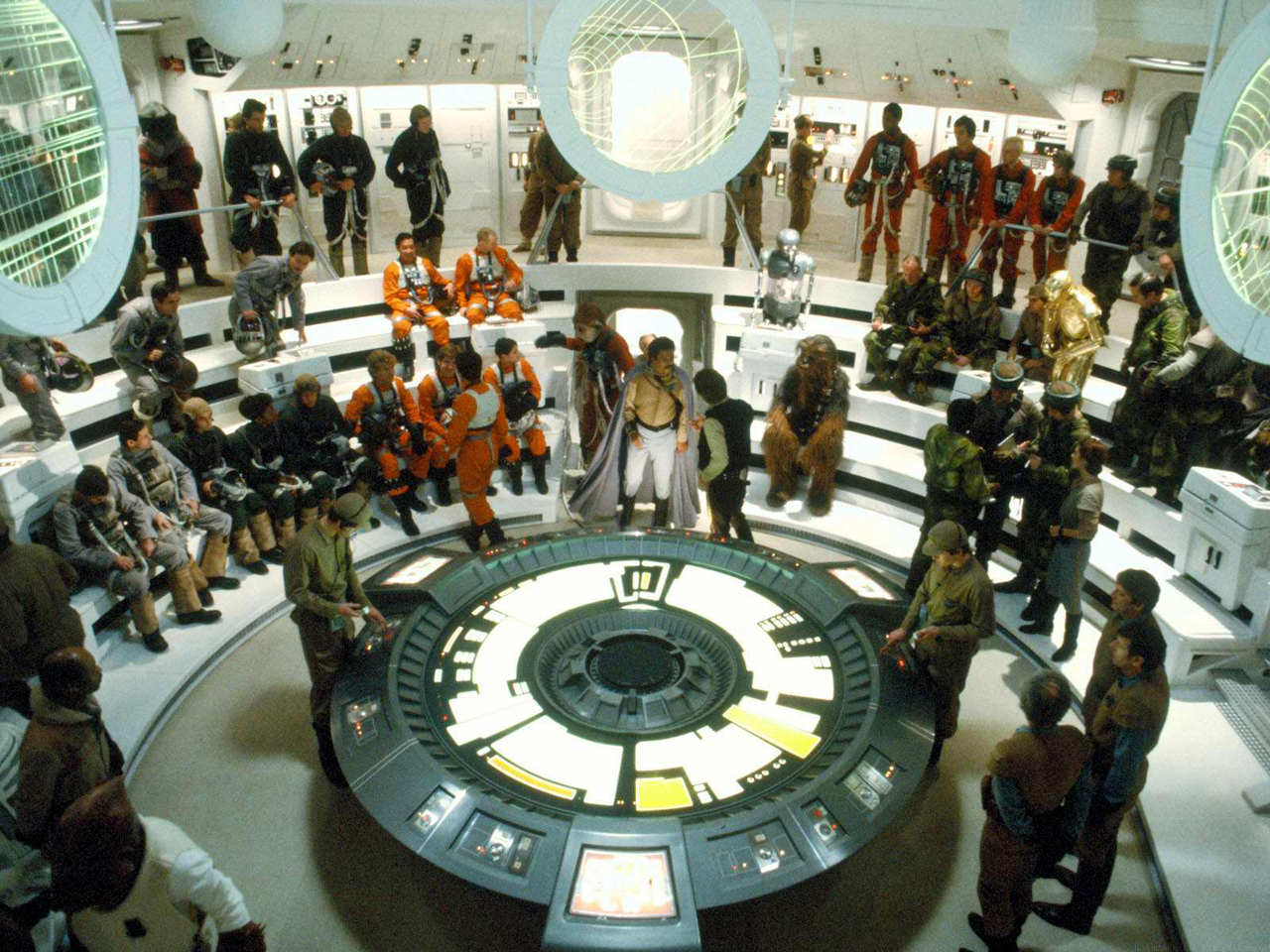
Whites, Oranges, Reds, and Silvers are the Primary Colors of the Rebel Alliance
They usually give a safe, secure, positive presence, their colors are soft, warm, and yet firm and serious, it also has a few sharp blues here and there, it makes the ships and buildings nice to look at, nice to be in, and the flagship Home One has a feel of a sanctuary.
Now take a look at the Empire, its Death Star II

Greys, little Whites, Carbon Black, little accents of Blood Red and Copper are the Empire's Colors
A very strict and cold colors, harsh and oppressive, also it should be noted that the Nazi's had colors of grey and black with bits of red mostly with the SS, which some say the Empire's motif was based on, I agree more or less but thats a different debate. The whole point is that you can tell this formers-Republic has been infected and corrupted by the Sith, and if you play the Knights Of The Old Republic series, the Sith Empire was a lot like this, only with more black.
Pop-Culture Cinema has used this type of formula heavily when they make film franchises they want to be memorable, and I say its a rather brilliant one.
Wednesday, March 25, 2015
Tuesday, March 24, 2015
Music in "The Man with the Movie Camera"
The inherent paradoxical nature of “The Man with the Movie Camera” is that even though you are looking at images flashed at such a fast pace, instead of the effect being jarring it serves to draw you into the film. The fast paced, harsh tone of the score combined with the rate the images are cut at works to engage the audience when the scenes are moving quickly as opposed to knocking them out of the first hand experience of watching the city’s inhabitants. Even though the pace changes occasionally, it is consistent and deliberate. The effect of the combination of the speed of both the sound and image places the viewer into an almost trance-like state so that the information the images are displaying can hit them harder. The point of “The Man with the Movie Camera” seems to be the every day life of a normal Russian city, but when it’s stylized as in this film the images take on a beauty and life of their own. “The Man with the Movie Camera” seems to be as much an ode to the magic of film editing as the city we are shown. In Walter Murch’s metaphor every cut is a blink, but in this film we don’t mind the effect.
Intellectual Montge
The significance of Intellectual montage is prevalent through the history of film. "Man with the Movie Camera" was one of the first films to portray a realistic and abstract juxtaposition of the rich versus poor structure. The intellectual montage is presented in a scene where a woman is getting pampered, smiling and laughing, while a different woman is characterized working outside, covered in dirt and sweat. As the shots change back and forth between the two women, the viewer begins to understand the emotion of the struggling poor woman versus the rich pampered woman.The general focus when viewing intellectual montage is emotion and perception of the shots. The meaning does not exist in the individual shots, but rather only when they are juxtaposed. During this montage, the viewer begins to think more deeply about how the two contrasting illustrations depict the two women living completely different lives, which gives it a dominant emotional effect. In conclusion as a result of editing, intellectual montage was a significant cinematic technique in "Man With the Movie Camera".
Man with a Movie Camera
"Man with a Movie Camera" was a rather experimental film and was innovative for the time it was made in. The film comprised of many random shots all over the world that in the end, told a story. Many different angles are seen throughout the film and the editing of the film for the time is impressive. The director of the film portrayed many opposites in the film such as the women getting their hair done compared to another shot of lower class women to show the contrast. The editing was very specific to go with the pacing of the music. When the music would get intense and fast,the scenes would cut accordingly to the fast downbeats and then slow down when the music slowed down and this would also be used to produce different moods such as a feeling of calm or a feeling of chaos.
Sunday, March 22, 2015
The Man
Recently in Media and Society class, we screened The Man with a Movie Camera. This film was made in 1929. Being an early experimental film, the entertainment value of this production is almost as significant as it was in the late 1920's. It was amazing being exposed to the general way of life eight and a half decades ago. In relation to the time period the film was released, this film was a story with no actual story and no scripted characters. The main character was the actual man with the camera.
The man was in the world collecting random shots that in the end told a story through symbolism. The audience was exposed to an event, then the opposite of the first event. For example, illness and death was presented, then a woman experiencing birth and then the baby being born. Then symbolism was shown to support the opposites; an example was the change in direction of the traffic signs. This style and content portrayed in the film kept it interesting at all times. It was never obvious what was going to happen next.
I also found the dangerous methods of getting the shot very appealing. The cameraman would go to any extreme to get the shot. He stood either in the back of a truck or on the edge of a building quite frequently. The style of seeing him get the shot then viewing the captured motion picture through his lens also added to the excitement.
This screening of The man with a Movie Camera was a great experience and also entertaining. The randomness and conflicted shots were the best parts. Messages were presented and translated to us viewers in very basic and affective ways. At the end of the day, whether its today, or in the late 1920s, this film made its audience think similar and different ideas through the medium of cinema.
Subscribe to:
Posts (Atom)